


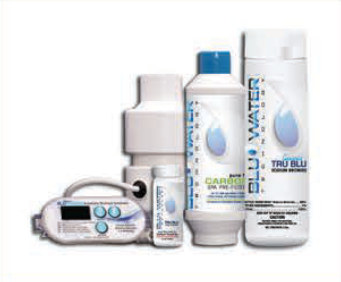

What is Blue Fusion?
Instead of juggling several chemicals to keep spa water clean and clear, the only thing you add with Blue Fusion is salt, and only about once a year.
It is not table salt. Blue Fusion uses sodium bromide (NaBr) rather than sodium chloride (NaCl), and the TRU BLU sodium bromide comes from the Dead Sea. The Blue Fusion generator converts that salt into bromine, which is the sanitizer in your spa.
How it works
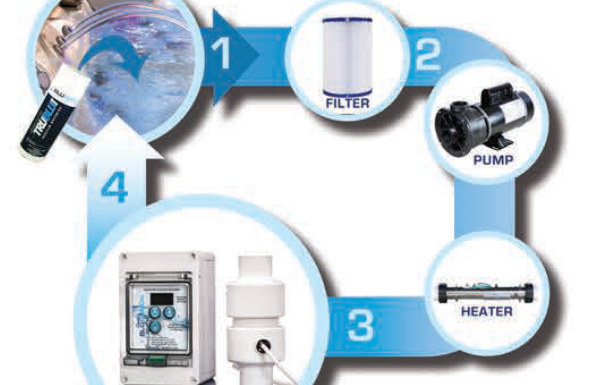
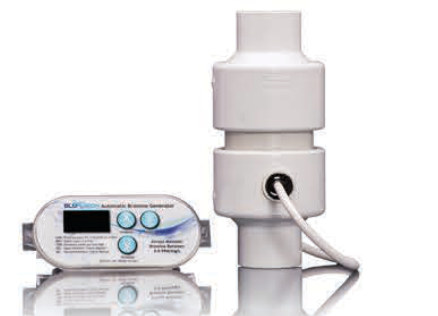
Blue Fusion has three parts: an electronics box, a control display and an electrode cell. The electronics box and electrode cell take the place of an ozonator in the equipment bay and plumbing, and the display usually mounts in the equipment bay door.
Once it is installed, you add TRU BLU salt to the spa (about 1.2 lb per 100 gallons, roughly 5 lb for a typical spa). The salt is the source of the bromine, and it also makes the water conductive.
While the spa is circulating (filtering), the water passes through the electrode cell. A very small electrical current, no more than a standard 9-volt battery, converts the sodium bromide into bromine. Once the bromine has done its work, it returns to salt and the cycle repeats.
The output is adjustable from 0 to 12 so you can match it to how much the spa is used. Most spas run between 2 and 6, and higher settings are there for heavy use or larger spas.
Why bromine?
Chlorine, bromine and biguanide are the only three sanitizer types approved by the EPA for pools and spas. Bromine is the better fit for hot water.
| Bromine (Blue Fusion) | Chlorine | Biguanide | |
|---|---|---|---|
| In hot water | Stays in the water at spa temperatures, so it is stable. | Off-gasses at normal spa temperatures of 95 to 104 degrees. | Not applicable. |
| pH sensitivity | Keeps killing bacteria even when pH drifts outside 7.2 to 7.6. | Loses much of its strength as pH rises. At 7.8 it has lost close to 75% of its effectiveness. | Needs very precise use to be effective. |
| By-products | Little odor, and they keep sanitizing. | Noxious and do nothing to kill bacteria. | Not applicable. |
| Oxidizing | Yes. It also breaks down waste such as dead skin cells. | Yes. | No. Waste stays in the water and feeds bacteria. |
| Ease of use | Simple, and generated automatically. | Needs regular dosing and careful pH control. | Hard to get right. |
TRU BLU salt
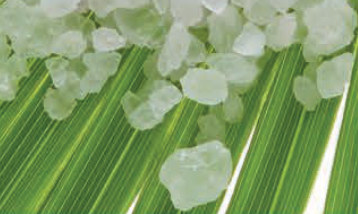
TRU BLU is 99% pure sodium bromide (EPA Registration Number 90052-1), harvested by evaporating Dead Sea water in the Jordan Rift Valley. The Dead Sea is so salty that you cannot sink in it.
Sodium bromide is mined in two places in the world: Israel and China. BluWater chose Israeli salt, even though it costs more.
The water will not taste salty. A person can taste salt at around 3,500 ppm, and a Blue Fusion spa runs around 1,700 ppm or less. The salt makes the water feel silky smooth instead.
Why Blue Fusion
- Soft, silky water that is gentler on your skin
- Salt is the only chemical you add, with no weekly dosing and no tablets to remember
- Drain and refill once a year instead of every three to four months
- No ozonator needed
- Runs on a very low voltage that never exceeds 12 volts
- Fewer chemicals and less water used, so it is easier on the environment
One drain a year
Spas are usually drained every three to four months for two reasons: dissolved solids (TDS) build up and cyanuric acid (CYA) builds up.
Every weekly chemical addition raises TDS, which makes water harder to keep clear, causes foaming and makes pH harder to control. Blue Fusion adds its salt only once per cycle, so TDS barely rises.
Most chlorine spas use dichlor, which is about half CYA. CYA stabilizes chlorine, but it also weakens its ability to kill bacteria as it builds up, which is why those spas need frequent water changes. Bromine does not use CYA at all.
Cost and effort
Floating bromine tabs or dichlor have the lowest up-front cost. Over the life of a spa the difference is small, and both take more of your time and are more likely to leave you with poor water on the weeks you forget to dose.
BluWater estimates that, including the initial cost of the generator, Blue Fusion works out to around $400 a year over a 10-year spa life, with far less time and effort than other methods.
Is it chemical free?
No, and nothing that sanitizes water is. Killing bacteria and removing waste requires a chemical. Blue Fusion uses only sodium bromide, a salt, and converts it to the bromine that does the sanitizing. Nothing else is needed to keep the water clean and clear.
Blue Fusion TS
The Blue Fusion TS system includes an electronic module, an electrode cell and top-side controls. The top-side controls can be mounted on any surface within 6 feet of the electronic module.
It is also available with a sacrificial anode. The anode prevents galvanic corrosion, as in any salt-system pool, and protects the spa heater, which is typically the most vulnerable part of any spa.
Blue Fusion handles standard hot tubs of roughly 200 to 600 gallons and swim spas up to 2,500 gallons.
Water care guide
Blue Fusion makes spa care easy, but it is not maintenance free. Test your water regularly and keep it within these ranges.
| Measure | Target | Why it matters |
|---|---|---|
| Bromine | 3 to 5 ppm | It is both your sanitizer and your oxidizer. Do not let it sit below 3 or above 5 ppm for long. Test before you get in, because bromine is used up as you use the spa. |
| pH | 7.2 to 7.6 (ideal 7.2) | Bromine still works outside this range, but keeping pH at or under 7.6 prevents calcium scaling. pH slowly rises with salt systems, so starting at 7.2 gives you room. |
| Total alkalinity | 80 to 120 ppm | Helps slow the natural rise in pH. |
| Calcium | 150 to 250 ppm | Protects metal parts from corrosion and helps reduce foaming. Blue Fusion still works at 500 to 600 ppm, but pH control matters even more at that level. |
| Phosphates | Below 200 ppb (ideally below 30 ppb) | Phosphates feed algae and interfere with bromine readings. If you cannot hold 3 to 5 ppm bromine, check phosphates first. |
| Salt | About 1,700 ppm or less | More than this can trigger high-current readings. |
| TDS | Under 200 ppm before adding salt, under 2,500 ppm with salt | Above 2,500 ppm, Blue Fusion may not operate properly. |
Fill with a pre-filter
Mineral content and pH vary a lot from place to place. A spa pre-filter on your hose when you fill the spa helps you start with the best water. If your tap water contains metals, add a metal sequestering agent, because metals prevent Blue Fusion from operating properly.
Testing your Blue Fusion system
- Make sure the spa is in circulation (filtration) mode so the system has power.
- Unlock the display.
- Hold the Increase and Decrease buttons down together for about 5 seconds.
- The display switches to a reading with a decimal. A reading of 1.0 to 1.4 means the system is set up and operating properly, and 1.2 is ideal.
Display messages
| Message | Meaning | Possible causes |
|---|---|---|
| LC (Low Current) | Current is flowing but not enough for proper operation. | Not enough TRU BLU salt in the water, or calcium scaling on the electrodes. |
| OE (Open Element) | No current is flowing through the electrode cell. | No salt in the water, heavy scaling, the cell is not connected to the electronics, or the cell needs replacing. |
| HC (High Current) | Too much current is flowing through the cell. | TDS above 2,500 ppm, or too much salt in the water. |
| bSt (Boost) | Boost mode is on. | Press the Boost button to turn it off. |
| LOC (Lock) | Settings are locked. | Hold the Increase button for 3 seconds to unlock. |
Troubleshooting
Common questions
Blue Fusion is an option on every Star 3500 model and on the Jewel Series. Ask your dealer about other models. Blue Fusion is not compatible with ozone, so on a Jewel spa the ozone is removed when Blue Fusion is chosen. Blue Fusion and TRU BLU salt are made by BluWater Technology.